










































ICT-Enabled Info-Kiosks for Knowledge-Based Community Empowerment of NREGA Workers
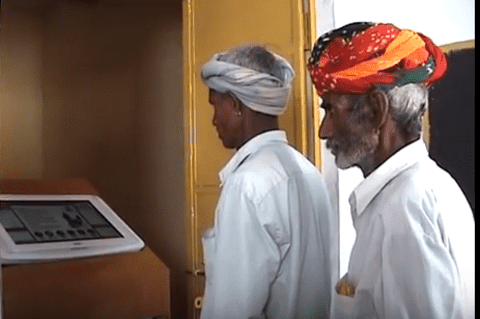
"...simplified information access for people at the grassroots..."
In 2010, OneWorld Foundation India launched an information and communication technology (ICT) initiative to help empower workers about an Indian labour law and social security measure that aims to guarantee the "right to work" under the Mahatma Gandhi National Rural Employment Guarantee Act (MGNREGA). The pilot project was delivered to 10 villages located within 12 kilometres of Suwana block office in Bhilwara district of Rajasthan and 10 villages located within 12 kilometres of Koraber Gram Panchayat in Udaipur. The aim of the ICT innovation is to improve access to knowledge and information at the grassroots for enhanced accountability and transparency, enabling the economically poor to demand rights-based entitlement for economic development.
The project uses a mix of technologies and social media to improve communication of workers' rights, minimise human intermediation, and enhance transparency in transactional processes associated with MGNREGA. Passed by the Indian Parliament on September 5 2005 and later renamed MGNREGA, the National Rural Employment Guarantee Act (NREGA) 2005 is an "Act to provide for the enhancement of livelihood security of the households in rural areas of the country by providing at least one hundred days of guaranteed wage employment in every financial year to every household whose adult members volunteer to do unskilled manual work and for matters connected therewith or incidental thereto."
For example, Soochna Seva Kendra are voice-based (Hindi) and icon-driven information kiosks deployed in Bhilwara and Udaipur to help neo-literate villagers get information about the Act and worker entitlements, identify worksites, request jobs under MGNREGA, collect details of work done (print receipt), demand wages, access pay slips and history of past work, register grievances, etc. The kiosk is a touch screen with bio-metric authentication (there is bio-metric registration of a thumb impression of the registered job-card holder along with a digital image). A job card details include the number of days worked, number of days left to work, and wages earned. There is a single job application process and desire for replacement of manual processing of dated receipt, which eliminates dependency of workers on the Panchayat for information. Workers have the option to select their preferred worksite. A dated receipt acknowledging their demand is also issued. Work allocation is integrated through a centralised management information system (MIS) and reflected in the info kiosk, which simplifies the process and ensures timely allotment of work.
Various tools are included in the scheme to extend outreach beyond the kiosk itself. A handheld device has been created that includes a portable computer with integrated peripheral devices, such as a biometric, camera, touch screen, integrated geographic positioning system (GPS), general packet radio service (GPRS) and wireless connectivity, a smartcard reader, and a thermal printer. Attendance is taken through such a handheld device at the worksite, with biometric authentication of workers; this eliminates the problem of "ghost workers". The GPS-enabled handheld device provides latitude and longitude of the location. An attendance report is available online with geographical tag and worksite images along with list of worker names and corresponding job identification (IDs). These tools and processes are designed to enhance transparency. Also included is an update of worksite progress with pre-post work images, as well as update of work measurement through the handheld device. Online access to data reduces processing time, and e-payment advice to banks ensures timely payment to workers. SMS (text)-based delivery of workers' information means, for example, that workers have the option of sending a SMS to receive job status information - number of days worked and number of workdays left - on their mobile phones.
The Panchayat secretary uses the information generated by these ICT tools to allocate work and generate "e-muster rolls". In addition, officials can remotely monitor the progress of the work.
Rural Development, Democracy and Governance, Economic Development, Rights
Ministry of Rural Development, United Nations Development Programme (UNDP) India, and OneWorld India Foundation.
Posting by Tej Prakash to the Community Media Network on The Communication Initiative platform, April 30 2016; "End to End Biometric Enabled ICT based transactions for MGNREGA: Experiences from Bhilwara" [PPT], by Naimur Rahman; and NEGRA document [PDF], accessed May 11 2016.
- Log in to post comments