










































"I will be there even if my bodyguards refuse to accompany me."
Author: Shirazuddin Siddiqi, October 10 2016 - Scores of people were killed or injured early last month when twin bomb blasts hit Kabul and armed assailants attacked the buildings housing an international charity.
We were due to record an episode of our discussion show Open Jirga the next day on the theme of ‘empowered women, prosperous Afghanistan’. Given the uncertainty of the security situation, our producers worried whether anyone would attend. The chances of the recording going ahead seemed slim.
Staff, whose day started at 5am, faced huge logistical challenges. They needed to ferry members of the studio audience, who were staying in a hotel, safely through the city to Radio Television Afghanistan (RTA) - the country’s national broadcaster. Kabul’s roads were completely blocked by a tight security cordon. Fighting was still going on and security forces had cordoned off large areas of the city.
Two members of the team decided to set out on foot, guiding a small group through back streets to the studio. It took them about an hour to negotiate their way through various check-points. A second group took another route and by 9am most of the crew and audience had arrived safely.
The presenter of Open Jirga, Daud Junbish, had abandoned his car after an hour of trying to get through the gridlocked traffic. On the way, he spent a good degree of time planning for a number of different scenarios: what if there’s only a small audience? What if all or some of the panellists can’t make it? His thoughts were constantly interrupted by the sound of gunfire from the area near the charity whose offices were the site of the attack. He made it to RTA soon after 9am and went into planning mode with those who had already arrived.
No matter what
Soon after this, the producer of Open Jirga, hesitantly picked up the phone to check if members of the all-female panel would brave the perilous journey. Delbar Nazari, Minister of Women’s Affairs, gave an energetic and encouraging response, saying: “I will be there even if my bodyguards refuse to accompany me”
She was as good as her word – arriving an hour before the show was due to start and chatting to female members of the audience. Nasrin Oryakhil, Minister of Labour and Social Affairs, did the same and arrived way ahead of schedule. At this stage, getting a full panel looked closer to reality. The two other panellists, Hasina Safi (Director of the Afghan Women’s Network) and Sima Joyinda (former governor of the Ghor province in Western Afghanistan) arrived shortly after.
Equality between men and women
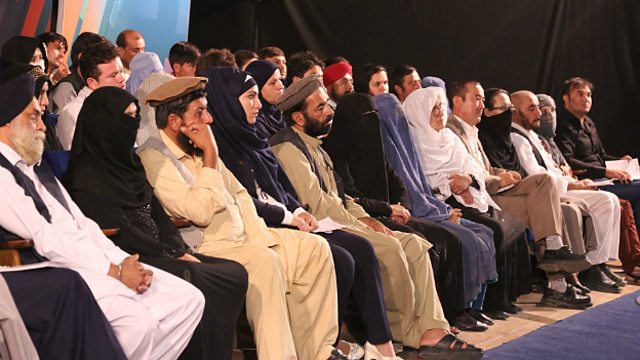
Incredibly, despite ongoing fighting in the centre of Kabul, the recording started five minutes ahead of schedule. The opening credits rolled and a woman stood up in front of a full audience to ask the first question: “'Why, after so much effort, are women in Afghanistan still not equal to men?"
The emotions among the team members at this moment cannot be described. What had seemed impossible was made possible thanks to the sheer determination, dedication and commitment of the Open Jirga team, the audience and the panel. The experience made us more hopeful about the future of Afghanistan. It showed that, despite the security challenges, men and women are more than willing to demonstrate exceptional courage and commitment to be able to discuss issues of national importance on national TV.
Click here to access this BBC Media Action blog and related links on their work.
Image credit: BBC Media Action
Contact:
BBC Media Action
BBC Media Centre, MC3A, 201 Wood Lane
London
W12 7TQ
United Kingdom (UK)
Phone: 44 (0) 20 8008 0001
Fax: 44 (0) 20 8008 5970
Media.action@bbc.co.uk
- Log in to post comments